
You can practise Spanish even when you only have a little free time. These three activities use different time commitments: cooking, puzzles and TV.
These activities are easy to turn into useful Spanish practice at home, especially when you say the words aloud and repeat them regularly.
Practice activities to try at home
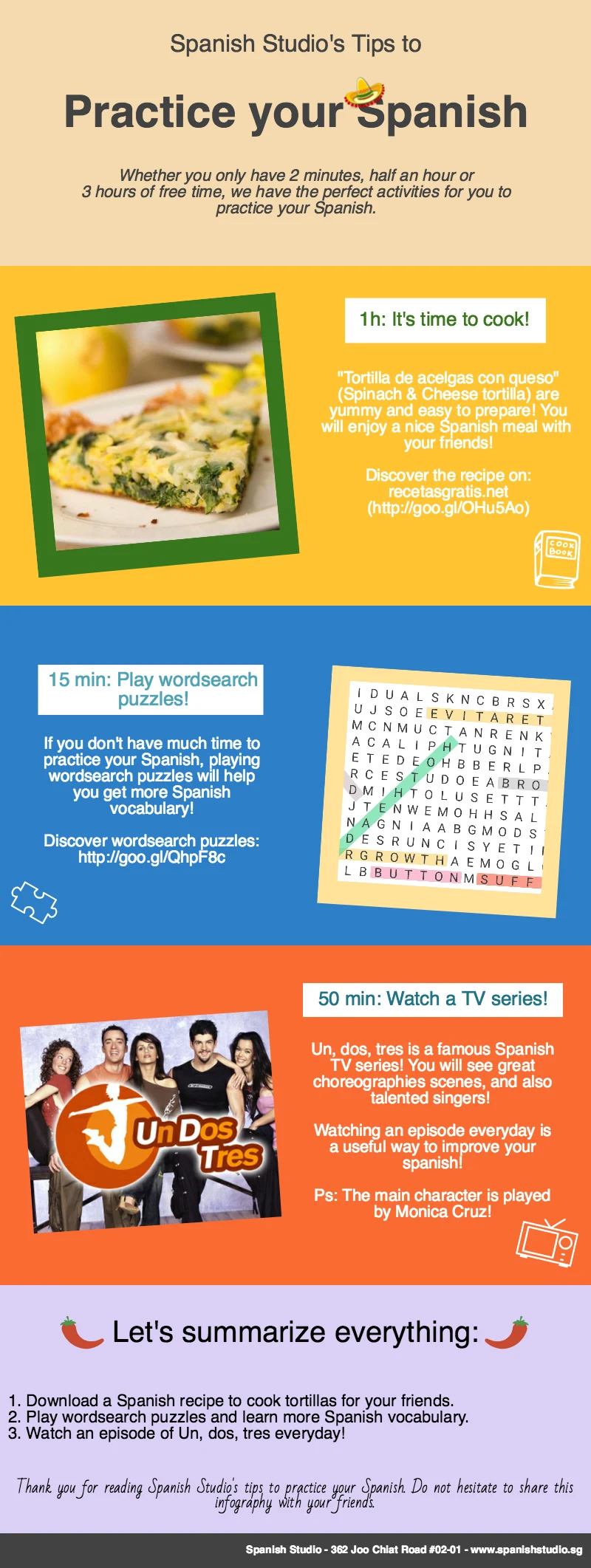
1 hour: cook tortilla The infographic suggested tortilla de acelgas con queso, a spinach and cheese tortilla. Cooking is useful because it gives you food vocabulary, verbs for instructions and a natural reason to say quantities, ingredients and taste words.
15 minutes: play word-search puzzles If you do not have much time, word-search puzzles can help you notice spelling patterns and build vocabulary. They are simple, but they force your eyes to recognise Spanish words quickly.
50 minutes: watch Un, dos, tres The infographic recommended the Spanish TV series Un, dos, tres and mentioned its choreography scenes and singers. Watching one episode gives listening practice, pronunciation rhythm and cultural context.
Make the activity active
The trick is to avoid passive practice. Before cooking, list five ingredient words in Spanish. Before a word-search, say each word aloud. Before a TV episode, choose one scene and write down useful phrases.
After the activity, summarise it in Spanish: cociné una tortilla, encontré palabras nuevas, or vi un episodio. Short sentences are enough if they help you reuse the vocabulary.
How can I practise Spanish when I am busy?
Choose small activities you can repeat: cooking with Spanish vocabulary, quick puzzles, one song or one TV scene. Consistency matters more than a long study session once in a while.
Is watching Spanish TV useful for beginners?
Yes, if you make it active. Use subtitles when needed, repeat short phrases aloud and write down words you can reuse in class or conversation.