
Some Spanish words sound alike or are spelled in a similar way but do not mean the same thing. Part I focuses on five pairs beginners often mix up.
These five tricky pairs are easier to learn with short explanations, clear examples and a little pronunciation practice.
The five tricky pairs in Part I
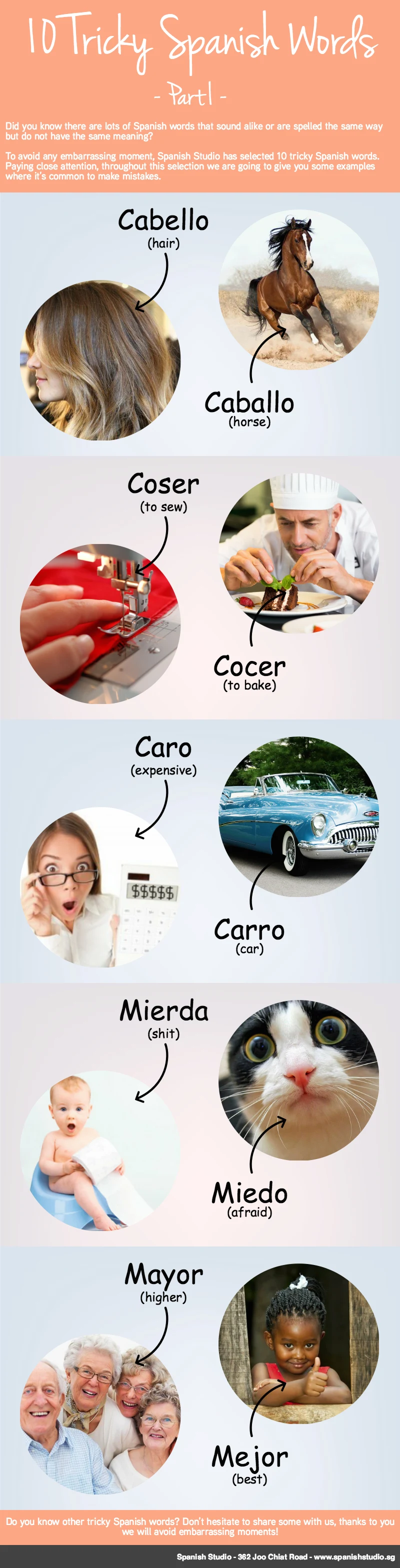
Cabello and caballo look similar, but cabello means hair and caballo means horse. The double l and the vowel change matter, so practise the words in full phrases: cabello largo, long hair; un caballo marrón, a brown horse.
Coser and cocer differ by one letter. Coser means to sew. Cocer means to cook, boil or bake depending on the context. If you are talking about fabric, use coser. If you are talking about food, cocer is usually the one you need.
Caro and carro are easy to mix up because the rolled or tapped r changes meaning. Caro means expensive. Carro means car in many parts of Latin America, though coche is common in Spain.
Mierda and miedo are very different words. Mierda is a vulgar word meaning shit, while miedo means fear or afraid. The infographic uses this pair because a small pronunciation mistake can create an embarrassing sentence.
Mayor and mejor are both common comparison words. Mayor can mean older, bigger or higher depending on context. Mejor means better or best. Compare mi hermano mayor, my older brother, with mi mejor amigo, my best friend.
How to use this infographic
Do not only read the pairs once. Say each pair aloud, write one example sentence for each word, and check whether the sentence context makes the meaning obvious.
The text article is here to support the image, but the infographic should remain the main study tool: it is quick to scan and easy to revisit before class.
How should I study confusing Spanish words?
Study each word in a short sentence, say it aloud, and compare it with the word it is often confused with. Context is more useful than memorising one English translation.
Can Spanish Studio help with pronunciation and vocabulary?
Yes. Group classes and private tuition give learners teacher correction, speaking practice and structured revision so tricky words become easier to use naturally.